


When it comes to console music players, there are pretty decent options out there, and MOC is one of them. Together with applications like mp3blaster or the powerful CMus program, MOC, which stands for Music On Console, uses the Ncurses library, with a text-user interface, support for playlist, shortcuts and more.

Process viewer: htop
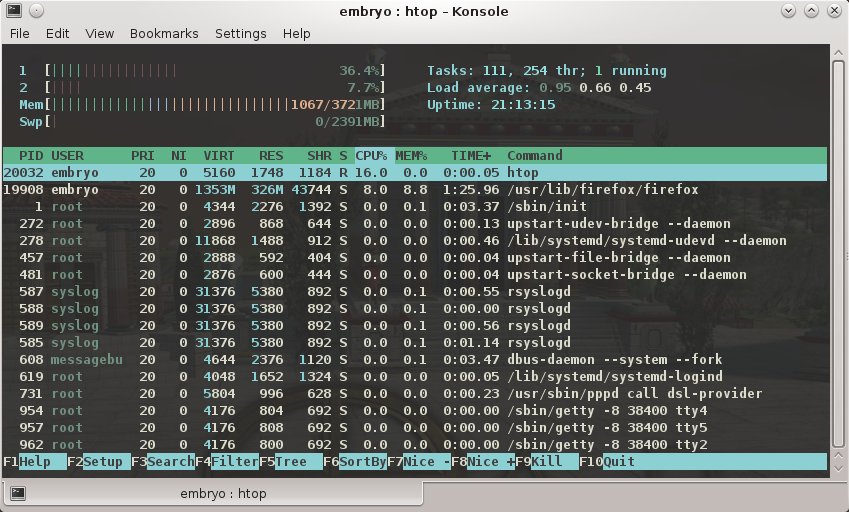
htop is an improved version of top, a complex process viewer which allows to visualize processes in real time, see memory and CPU consumption, send signals to processes, renice processes, and sort them by various options. It makes use of colors and you can also scroll horizontally and vertically to see the full names of the running processes.
tint
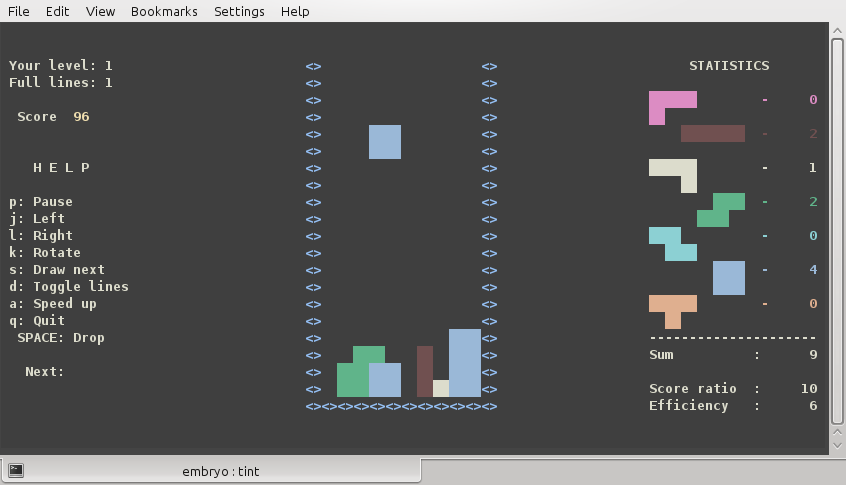
Standing for TINT Is Not Tetris, that’s exactly what it is. A terminal-based tetris clone with highscore saving and 9 levels. Among the tetris clones for Linux, TINT is one of my favorites. Use J to move pieces left, L to move them right, K to rotate and SPACE to accelerate. Press Q to quit. On Ubuntu at least, there seems to be a problem when saving highscores due to permissions not allowing it (Error creating /var/games/tint.scores). You can fix it by doing something like this: sudo touch /var/games/tint.scores && sudo chown $USER:$USER /var/games/tint.scores.
Homepage
In this tutorial I’ll show how to get some nicely colored man pages by adding several lines inside the .bashrc file, explaining what the code means and how it works.

GNU find is a powerful command-line utility that lets you search for files and folders in a hierarchical tree directory structure. It is the backend for all those utilities out there like the graphical searching in KDE or GNOME. However, find can be a little hard to handle at first by beginners. In this tutorial I will try to explain some of the capabilities of find, show some useful one-liners and provide more explanations regarding this command.
The older way of doing this, with gconftool-2 doesn’t seem to work anymore in GNOME 3 – used to be something like: gconftool-2 –type string –set /desktop/gnome/background/picture_filename “/full/path/to/file.png”.
However, there is still possible to change the background image, by using the gsettings tool instead. You will need the libglib2.0-bin package, which is probably already installed on your system. To change the background, use a command like the following:
CMus
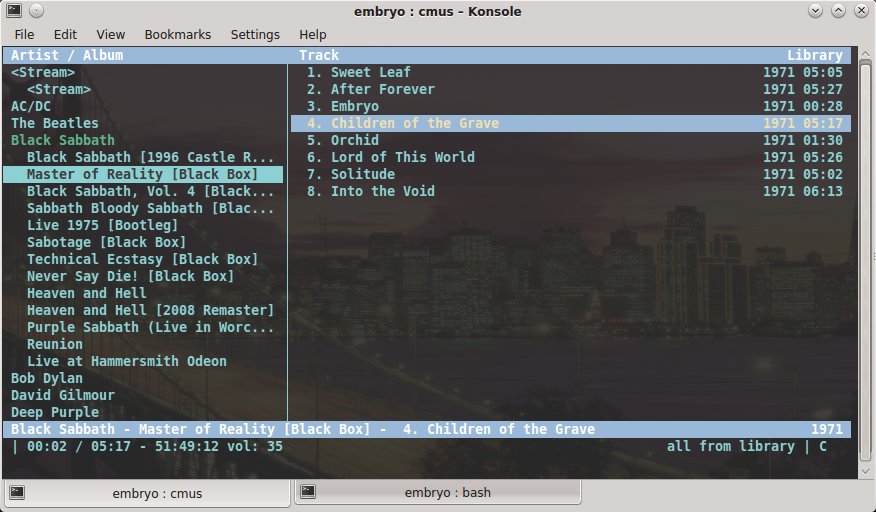
This is one of the best, feature-rich players for console. Built using ncurses and thus offering a text user interface, CMus has several view modes, organizes your music by artist/album, provides playlists and a library view, a filebrowser, it allows searching, Last.fm/Libre.fm scrobbling via this script, and it uses Vi-like keyboard shortcuts. A complete review can be found here and a guide to using it here.
Homepage
CMus is a powerful, feature-rich music player for the terminal which uses the Ncurses library:
This article is about two popular IM (Instant Messaging) clients that can be used in a terminal instead of a graphical environment. Both have advanced features and are based on the ncurses library.
Finch
Based on libpurple, Finch is developed by the Pidgin project, and it pretty much supports the same features of it, except for the graphical part, of course. There are many chat protocols which it supports, including AIM, IRC, MySpaceIM, WLM, SILC, Yahoo! or ICQ.
First of all I’d like to thank TuxArena’s readers for giving good feedback in the first part of this series, which overviews 15 of the tools I consider particularly useful in a console. This article overviews 10 more such tools, and most of them were suggested by you. Screenshots included.
telnet
telnet is a well-known command-line tool which uses sockets to open a TCP connection to the specified hostname and port. telnet can be primarily used for non-secure connections to connect to a HTTP server and get a file or to an IRC server for example. Escape character in telnet is ^] (press Ctrl+])
Homepage
cmus
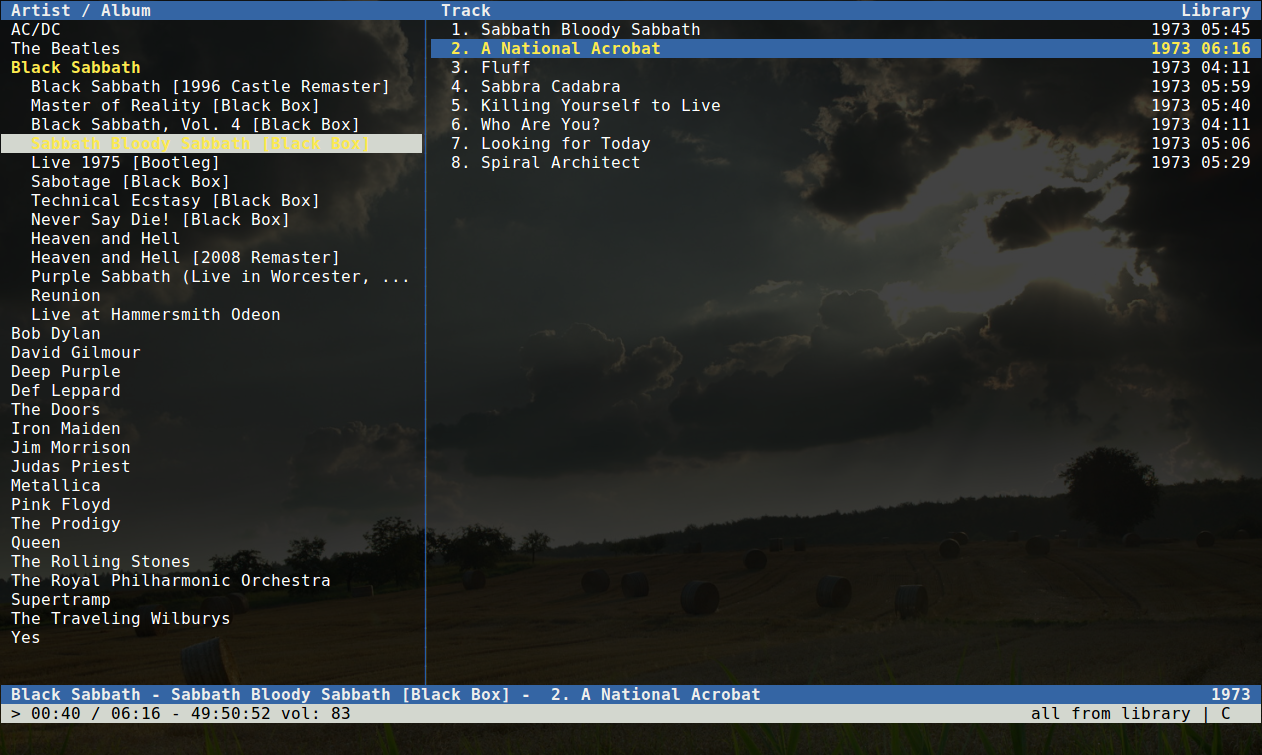
cmus is a music player that I admire the most when it comes to command-line because it’s really powerful and has a lot of nice features. It is built with ncurses and therefore providing a text-user interface. cmus is indeed feature-rich, with several view modes and Last.fm song submission support via scripts. It supports Vi-like commands and auto-completion with Tab too. Recently I wrote a full guide on how to use cmus, you can read it here.
Homepage
This is the second article in this series, and brings eight additional tips for working faster with the shell. Here is the first article of the series, containing 10 tips.
Create aliases for quick access to commands or one-liners
Aliases are handy custom commands which can be used to make shortcuts to various commands, scripts or one-liners. Aliases can be added in the ~/.bashrc file like this:
alias name='command'
Take a screenshot in command-line
Taking a screenshot in command-line is very easy using the import tool, which is included in the ImageMagick suite. To take a screenshot of a single window use:
To take a screenshot of a single window and include window decorations, use:
TuxArena is proud to announce the second free PDF giveaway: Command-Line Guide to Audio Files in Ubuntu. You can read it online here or download the PDF from here.
The guide explains the basics of manipulating audio files in command-line mode, as well as converting to and from various audio formats, with an accent on the free formats FLAC and Ogg Vorbis. Here are the topics covered:

- ColorCode 0.8.5 Mastermind Clone Game Gets Qt5 Support
- Pentobi Is a Blokus Board Game Implementation for KDE with Various Features
- 12 Labours of Hercules and Out of the Park Baseball 16 Now on Steam
- Red Eclipse 1.5 Overview & Screenshots
- Eschalon Book I, II & III 75% Off on GOG.com, Unrest 50%
- Steam Publisher Sale: Borderlands, BioShock Infinite, Civilization V and XCOM Up to 75% Off
- Tropico 5 75% Off, Free to Play Until Sunday